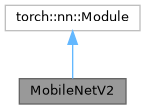
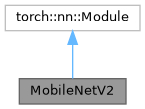
Implementation of MobileNetV2 as done in py-torchvision See: // https://github.com/pytorch/vision/blob/main/torchvision/models/mobilenetv2.py#L66. More...
#include <mobilenet_v2.h>
Public Member Functions | |
| MobileNetV2 (int num_classes=1000, float width_mult=1.0f, int round_nearest=8, float dropout=0.2) | |
| Construct a new MobileNetV2 object. | |
| torch::Tensor | forward (torch::Tensor x) |
| Performs the forward pass. | |
| void | initialize_weights () |
| Initialize conv/bn/linear similar to torchvision defaults. | |
| void | load_torchvision_weights (std::string pt) |
| Loads a .pt weight file containing a dict with key/parameter pairs. | |
| int | getNinputChannelsOfClassifier () const |
| Gets the number of input channels of the classifier. | |
| void | replaceClassifier (torch::nn::Sequential &newClassifier) |
| Replaces classifier with a new one. | |
| void | setFeaturesLearning (bool doLearn) |
| Enables/disables learning in the feature layers. | |
| torch::nn::Sequential | getClassifier () const |
| Gets the Classifier object. | |
Static Public Member Functions | |
| static torch::Tensor | preprocess (cv::Mat img, bool resizeOnly=false) |
| Preprocessing of an openCV image for inference or learning. | |
Static Public Attributes | |
| static constexpr char | featuresModuleName [] = "features" |
| Name of the features submodule. | |
| static constexpr char | classifierModuleName [] = "classifier" |
| Name of the classifier submodule. | |
Detailed Description
Implementation of MobileNetV2 as done in py-torchvision See: // https://github.com/pytorch/vision/blob/main/torchvision/models/mobilenetv2.py#L66.
Constructor & Destructor Documentation
◆ MobileNetV2()
|
inline |
Construct a new MobileNetV2 object.
If you want to load the weight files from torchvision into this class use the default values for the parameters.
- Parameters
-
num_classes Number of classes. width_mult Width multiplier - adjusts number of channels in each layer by this amount. round_nearest Round the number of channels in each layer to be a multiple of this number. dropout Dropout probability for the dropout layer in the classifier.
Member Function Documentation
◆ forward()
|
inline |
Performs the forward pass.
- Parameters
-
x The batch of input images.
- Returns
- torch::Tensor The category scores for the different labels.
◆ getClassifier()
|
inline |
Gets the Classifier object.
Gets a shared pointer to the classifier, for example, to attach an optimiser for transfer learning.
- Returns
- torch::nn::Sequential
◆ getNinputChannelsOfClassifier()
|
inline |
Gets the number of input channels of the classifier.
This will make it easy to replace the classifier with anything the user wants by creating their own torch::nn::Sequential() for the classifier.
- Returns
- int The number of intput channels of classifier class "classfier".
◆ load_torchvision_weights()
|
inline |
Loads a .pt weight file containing a dict with key/parameter pairs.
See https://github.com/pytorch/pytorch/issues/36577 The difference between pytorch and libtorch is that pytorch just has named parameters but libtorch has both named parameters and named buffers. This method makes sure that the key/parameters pairs are loaded into both named buffers and named parameters.
- Parameters
-
pt filename of the .pt weight file.
◆ preprocess()
|
inlinestatic |
Preprocessing of an openCV image for inference or learning.
The images are resized to 256x256, followed by a central crop of 224x224. Finally the values are first rescaled to [0.0, 1.0] and then normalized using mean=[0.485, 0.456, 0.406] and std=[0.229, 0.224, 0.225].
- Parameters
-
img 8bit BGR openCV image with an aspect ratio of 1:1. resizeOnly If true the image is only resized to 224x224 but not cropped. Default: false.
- Returns
- torch::Tensor The image as a tensor ready to be used for inference and learning.
◆ replaceClassifier()
|
inline |
Replaces classifier with a new one.
For transfer learning the default classifier is replaced with a new one.
- Parameters
-
newClassifier The new classifier.
◆ setFeaturesLearning()
|
inline |
Enables/disables learning in the feature layers.
For transfer learning one needs to disable learning in the features submodule.
Member Data Documentation
◆ classifierModuleName
|
staticconstexpr |
Name of the classifier submodule.
This appears as part of the key in named_parametes and named_buffers.
◆ featuresModuleName
|
staticconstexpr |
Name of the features submodule.
This appears as part of the key in named_parametes and named_buffers.
The documentation for this class was generated from the following file: